
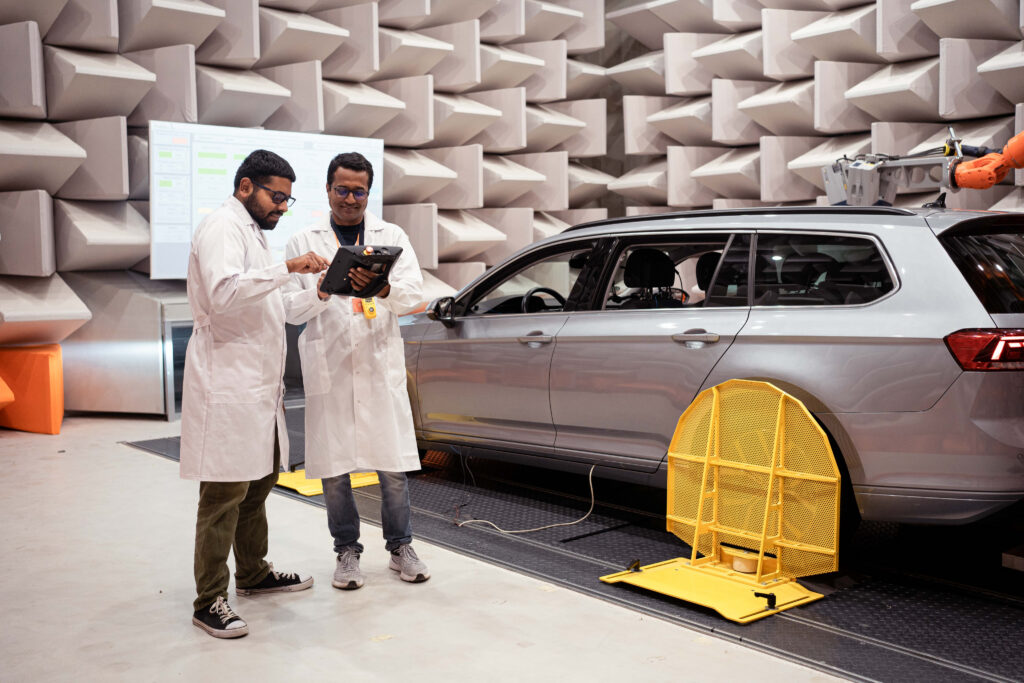
Interior Car Noise
This case study explores interior car noise, examining how various sound sources—powertrain, tires, wind, and airflow—combine and travel through the vehicle to influence passenger perception. Using NVH engineering principles, we analyze both unwanted noise and desirable sounds, considering factors like sound paths, passenger location, and road conditions. The study demonstrates how advanced measurement and material strategies can optimize in-cabin acoustics, enhancing comfort and driving experience.
Noise sources in the car
The sound perceived by passengers in the vehicle interior is a combination of sounds generated by various car components. The primary sources of sound in a moving vehicle include the powertrain, tire-road interaction, and wind. These sources behave differently depending on various operational modes, such as vehicle speed and road surface conditions. When analyzing the interior vehicle soundscape, more subtle sound sources may gain importance once they are noticeably audible. One example is the sound of the air vents, particularly when high airflow settings are selected.
The sound produced by the aforementioned sources is generally classified as noise. As a result, the sound design of vehicles primarily emphasizes noise reduction to ensure a quiet and comfortable interior. This focus on minimizing unwanted sound is part of a specialized field within automotive engineering known as NVH—Noise, Vibration, and Harshness—which involves identifying, measuring, and reducing noise and vibrations in vehicles to enhance passenger comfort and improve the overall driving experience.
However, it is important to note that sounds emitted by certain sources in a car can also be considered as desired sounds, which are intended to provide specific acoustic experiences. The sound quality criteria for these experiences are typically defined by sports car drivers and enthusiasts of high-speed driving. In this context, car sound design emphasizes enhancing the distinctive qualities of the sound sources rather than merely reducing noise, thereby positively contributing to the overall driving experience for sports car enthusiasts.
Perception of interior car noise
Apart from the characteristics of the sound sources themselves, the perception of noise in a car depends on several important factors, such as the source-ear path, passenger location, road surface, and car operational conditions (e.g. speed).
Source-ear path
The sound emitted by the aforementioned sources travels through various paths, altering its characteristics before reaching the ears of the driver or passengers. Sound may travel through structures (structure-borne) as well as through air (air-borne), and at each step of the way, it may be absorbed or amplified, depending on the properties of the path’s elements.
Sound absorption can be achieved by using sound-absorbing materials. Depending on the type of material, different levels of absorption across various frequency ranges may be achieved. This phenomenon plays a crucial role when noise reduction in a car is required.
Sound level attenuation, on the other hand, is a consequence of resonance phenomena that occur when particular structures or air cavities are specifically excited by sound traveling from the source toward the passenger or driver. This attenuation is also frequency-dependent.
Since there are many sound sources in a car, each finding various paths to reach the passenger’s or driver’s ears, the overall perception of noise in a car is influenced not only by sound level and frequency characteristics but also by the localization of individual noise components.
Passenger’s localization
As a result of different sound paths, the soundscape in a moving car is perceived slightly differently depending on the passenger’s location within the car. Hear the difference for yourself by listening to our example sound samples from the three proposed seating locations. The samples were recorded binaurally with a dummy head under laboratory conditions.
Road surface
The perception of noise in a car is also influenced by the type of road. Rough road surfaces or obstacles cause elements of the car to vibrate more intensively, resulting in an increase in sound levels within the car cabin. To experience the difference in noise generated by the car’s interaction with rough surface or obstacles compared to a smooth surface, listen to our sound samples, recorded binaurally in laboratory conditions using a dummy head positioned on the selected car seat.